Building GSDAQ
GSDAQ at the Alpaca AI Trading Agents Hackathon
Our public lablab team page, the idea behind GSDAQ’s indicators and AI-customized interface, and the difference between a hackathon concept and a live product.
A public record of participation
GSDAQ has a team page for the Alpaca AI Trading Agents Hackathon on lablab.ai. It lists June Kim, username imjunejk. The event page gives August 28–September 4, 2026 as its dates. This post records our participation and the product questions behind the idea. lablab.ai: GSDAQ team page · checked September 12, 2026
Sources: lablab.ai: Alpaca AI Trading Agents Hackathon · August 28–September 4, 2026
What the team page says—and what it does not
Our posted idea connects technical indicators and quantitative market data with price modeling and momentum research, alongside an interface users can customize with AI. As checked on September 12, the team page displays no submission yet. We are not announcing an accepted final submission, a prize, an audited trading result or an endorsement by Alpaca or lablab. lablab.ai: GSDAQ team page · checked September 12, 2026
The question we want to make easier to investigate
A signal is a starting point for research: which observation changed, how old is the input, and what would weaken the interpretation? In GSDAQ, the useful sequence is to inspect the source, compare the chart conditions, read the explanation and choose what to monitor. AI-generated prose, indicator calculations and historical-pattern scenarios have different jobs and different failure modes. A fluent explanation is not a verified price forecast.
From a market headline to a research routine
Imagine reading a company headline in the free feed. Open the relevant company, check timestamps, inspect available indicators and request a supported keyword, daily-percentage-move or agent-feed alert. Then organize the information with supported dashboard widgets. Review the saved condition and the next observation. This describes a GSDAQ research workflow, not an Alpaca order-execution pipeline.
Sources: GSDAQ: current product overview
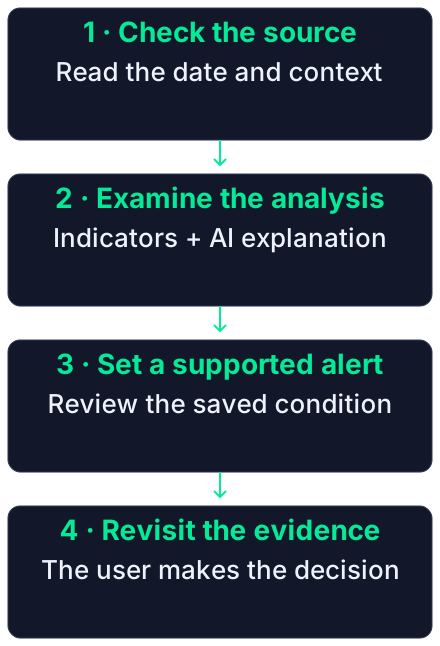
Read the diagram as text
- 1 · Check the source: Read the date and context
- 2 · Examine the analysis: Indicators + AI explanation
- 3 · Set a supported alert: Review the saved condition
- 4 · Revisit the evidence: The user makes the decision
Why paper trading needs its own evidence
Alpaca describes paper trading as a simulation whose results can differ from live trading. Testing an order workflow therefore requires evidence beyond a chart or model output. Our current public GSDAQ app provides research, explanations and alerts; it does not execute brokerage orders or hold customer funds. The hackathon idea does not change that product boundary. Alpaca documentation: paper trading and simulation limitations
Where the work continues
GSDAQ is also called 광스닥 in Korean. Our focus is making stock news, indicator context, AI analysis and configurable dashboards easier to understand together. The linked guides explain the current features and limitations. We will update this participation record if a public submission or result becomes available, with a date and a verifiable link. This is a static development note, not a live event-status feed.