Strategy research
Baby-TQ: a QQQ, TQQQ and Treasury-bill strategy
Understand GSDAQ’s Baby-TQ dashboard ladder, its 20/50/200-session rules, leverage risks and why a different synthetic backtest cannot validate this version.
What this Baby-TQ article describes
Baby-TQ, or 아기티큐, is the name used in our research for several related leverage-and-trend experiments. This article documents the L2 ladder displayed by the GSDAQ dashboard, based on the QQQ 20-, 50- and 200-session simple moving averages. It is an explanation of a rule, not a personalized allocation or an instruction to trade. A separate research system with different assets and exit rules must be evaluated separately.
Read the three rungs in order
With sufficient observations, the L2 rule selects the TQQQ rung when QQQ is strictly above all three averages. If QQQ is above its 200-session average but fails either shorter-average test, it selects QQQ. At or below the 200-session average it selects BIL. Equality does not pass an “above” test. The calculation needs 200 valid observations; a defensive fallback or missing card caused by insufficient data is not a measured bearish signal.
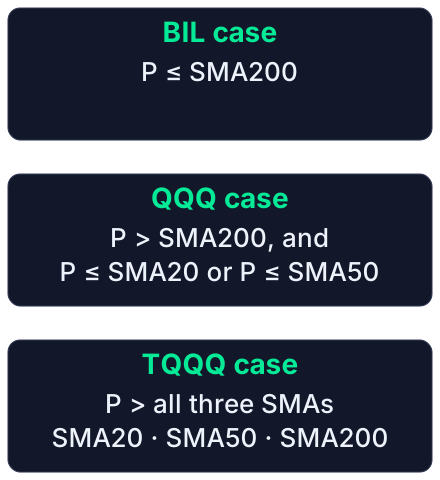
Read the diagram as text
- BIL case: P ≤ SMA200
- QQQ case: P > SMA200, and P ≤ SMA20 or P ≤ SMA50
- TQQQ case: P > all three SMAs SMA20 · SMA50 · SMA200
A small numerical example
Suppose, purely for illustration, QQQ is 510 and its 200-, 50- and 20-session averages are 480, 500 and 505. All three tests pass, so the example is on the TQQQ rung. If the same price instead faces a 20-session average of 515, the middle QQQ rung applies. If QQQ is 480 against a 200-session average of 480, the BIL rung applies. These invented values describe no actual market session and no strategy return.
TQQQ exposure is a daily objective
TQQQ seeks three times the Nasdaq-100’s daily performance before fees and expenses. Compounding means a multi-day holding can differ materially from three times the index’s total return. For an invented cost-free two-day path, an index rising 10% then falling 9.09% is approximately flat; a daily 3× series rising 30% then falling 27.27% ends roughly 5.45% lower. The rule does not remove gaps, whipsaws, trading costs or the possibility of a large loss. ProShares TQQQ: daily objective, inception and holding-period risks
The lower rung is still an investment
BIL holds exposure to short Treasury bills; it is an ETF with a market price and expenses, not a guaranteed bank balance. Its return changes with short-term rates and the holding period. In GSDAQ, compare the rung’s source time with the displayed price observations. A card can flag a difference between the source rung and a later recalculation. That discrepancy needs a timestamp check before treating it as a new strategy decision. State Street BIL: Treasury bill exposure and fund risks
Why we are not publishing an advertised Baby-TQ return
Our archive includes a separate long-history AgiTQ study with synthetic leveraged prices, a constant cash-return assumption and different regime/exit rules. Its headline results do not validate this L2 dashboard ladder. TQQQ’s actual inception was February 9, 2010, so a pre-2010 TQQQ series is necessarily reconstructed. A publishable L2 comparison needs the exact version, historically available inputs, realistic cash returns, next-observation execution and costs, plus untouched evaluation periods. Neither an internal simulation nor a smooth chart establishes a guaranteed return. ProShares TQQQ: daily objective, inception and holding-period risks