
The October 7 setup
The rate events this brief focuses on today, October 7, are a 10-year Treasury auction and the FOMC minutes. Competitive bidding in a $39 billion reopening of the 10-year note closes at 1:00 p.m. EDT. Then, at 2:00 p.m. EDT, the Fed releases the minutes of its September 15–16 meeting. With only an hour between them, the yield reaction should be recorded in two windows, auction and minutes, rather than as one move. As of this brief's cutoff (4:00 a.m. PDT, 7:00 a.m. EDT), neither result was out.
Sources: TreasuryDirect 10-year reopening announcement (October 1) · Federal Reserve October calendar
Monday's close: Large-cap records, small caps lower
These are cash index closes from the October 6 regular session (4:00 p.m. EDT, 1:00 p.m. PDT). Percentage changes are GSDAQ's calculations from AP's closes and point changes, against the prior close, shown to two decimals. The S&P 500 and Nasdaq Composite closed at records, but the Russell 2000 fell, so the whole market did not rise together. Whether rates explain the gap is not confirmed.
Sources: AP October 6 market close · AP via the Seattle Post-Intelligencer
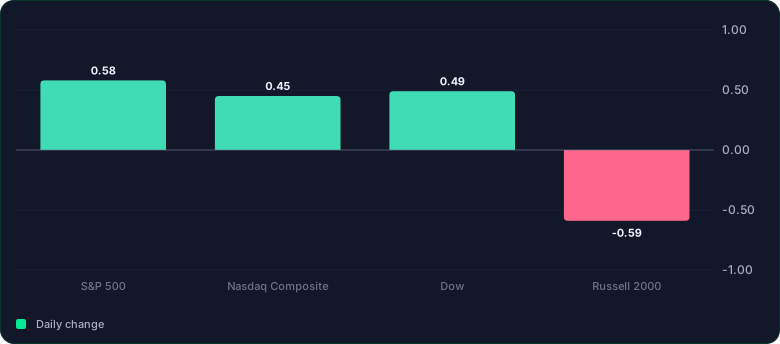
Read the chart as a table
| Daily change (%) | |
|---|---|
| S&P 500 | 0.58 |
| Nasdaq Composite | 0.45 |
| Dow | 0.49 |
| Russell 2000 | -0.59 |
On narrow screens, scroll the table sideways. Keyboard users can focus the table and use the arrow keys.
Overnight Reuters readings are article-time numbers
The figures below appeared in a Reuters article updated at 1:17 a.m. PDT (4:17 a.m. EDT). That is the article's update time, not when each price was observed, and not the market as of 4:00 a.m. PDT. The article cited supply worries from a storm headed toward US oil-producing areas and Houthi attacks toward Saudi Arabia as context for oil prices; that context is about oil. The 10-year yield is the article's figure, not an official Treasury close. The article gives no contract month or symbol for the futures. So the Nasdaq futures figure is not compared with the Nasdaq Composite's cash close, and it cannot serve as the baseline for today's 1 p.m. and 2 p.m. comparisons.
Sources: Reuters October 7 markets report (via MarketScreener)
On narrow screens, scroll the table sideways. Keyboard users can focus the table and use the arrow keys.
Today's timetable
Both rate events fall in the middle of the US afternoon session. The NYSE is open for a normal session today.
Sources: NYSE trading hours and calendars · Federal Reserve October calendar
On narrow screens, scroll the table sideways. Keyboard users can focus the table and use the arrow keys.
| Event | EDT | PDT |
|---|---|---|
| Regular session opens Source | 9:30 a.m. | 6:30 a.m. |
| 10-year reopening: competitive bids close Source | 1:00 p.m. | 10:00 a.m. |
| Minutes of the Sept. 15–16 FOMC meeting Source | 2:00 p.m. | 11:00 a.m. |
| G.19 consumer credit release (schedule only) Source | 3:00 p.m. | 12:00 p.m. |
| Regular session closes Source | 4:00 p.m. | 1:00 p.m. |
1:00 p.m. EDT: A $39 billion 10-year reopening
This is not a new 10-year issue but a reopening of an existing 10-year note: 9 years 10 months to maturity, maturing August 15, 2036, CUSIP 91282CRF0. The offering is $39 billion, announced by the Treasury on October 1. 1:00 p.m. EDT is when competitive bids close. The high yield and bid-to-cover ratio were not yet public.
Sources: TreasuryDirect 10-year reopening announcement (October 1)
2:00 p.m. EDT: September minutes, not a new decision
Today's release is the minutes of the September 15–16 meeting. It is not a rate-setting event; the next policy meeting is October 27–28. The minutes were not yet public. The benchmark is the September 16 statement. The Committee voted 12–0 to raise the target range by 0.25 percentage point to 3.75%–4.00% and described inflation as elevated. A unanimous vote does not mean every member prefers the same path for further hikes.
Sources: Federal Reserve October calendar · FOMC statement, September 16, 2026
GSDAQ's observation conditions
These are GSDAQ's observation plans, not predictions. 1) Auction (competitive bids close at 1:00 p.m. EDT): 1:00 p.m. is the bidding deadline, not the time results are published. Confirm and record the official release time separately, then note the 10-year yield around it, for example the same 10-year yield 5 minutes before, 5 minutes after and 15 minutes after the confirmed release time. Judge demand with the bidding data, not the high yield alone. Without a timed price just before the auction, the auction's effect is left undetermined. If the official release time or the yields at those times cannot be confirmed, the time and reaction stay unverified; an article's update time is not a substitute. 2) Minutes (scheduled for 2:00 p.m. EDT): look for conditions for further action, or discussion of inflation risks, that the September statement's hike and inflation assessment do not already explain. Separate the views of some participants from the Committee's decision. For the minutes, too, confirm the actual release time and watch yields at the same intervals; if that cannot be confirmed, leave the time and reaction unverified. Compare before and after on the same instrument, contract month, maturity and time basis, and separate a reaction that carried over from the auction results from a change that began after the minutes. 3) Index gap (intraday and close): check whether the S&P 500 and Russell 2000 keep moving in different directions. A large-cap record does not mean small-cap strength, and index direction is a different measure from the number of advancing stocks or market breadth. Oil and company news can move in the same window as the two events, so the order of events alone does not establish cause. The auction results and the minutes came out after this brief's cutoff and are not reflected here. This brief summarizes public information for educational purposes. It is not a recommendation to buy or sell any security and is not investment advice.