
October 8 premarket summary
Federal Reserve Governor Christopher Waller said in a speech early on October 8, Pacific time, that if economic data come in as expected, he expects further rate increases to return inflation to the 2% target in a more timely way. He added that the timing of increases can be flexible and they do not need to come at consecutive meetings, but they should happen within an appropriate period. This is one governor's conditional view, not a new decision by the Fed as a whole. This brief is based on information public as of 4:00 a.m. PDT (7:00 a.m. EDT) on October 8, 2026. As of that time, today's weekly jobless claims and 30-year auction results were not yet out.
Waller's speech: The direction of further hikes and their timing
Waller spoke at the Istanbul Economic Forum in a speech titled "The Signaling Value of the Summary of Economic Projections" (speech text). The speech took place at 1:30 a.m. PDT (4:30 a.m. EDT) and was public before this brief's cutoff (Fed October calendar). • Direction: If economic data come in as expected, he expects further rate increases. • Timing: The timing of increases can be set flexibly, and they do not need to come at consecutive meetings. However, they should happen within an appropriate period. • Economic assessment: Waller said new data reinforced his assessment that the labor market is stable and inflation is too high. He also said the September decision to raise rates was based on information accumulated over several months, not a single CPI report. Both assessments are Waller's personal judgments. A footnote in the speech text also states that the views expressed are his own and are not necessarily those of the Board of Governors or his FOMC colleagues. The next FOMC meeting is October 27–28. On October 7, the minutes of the September 15–16 meeting were released (minutes, press release). The minutes are the record of the September meeting, showing that many participants at the time judged, conditionally, that further increases would be appropriate by year-end. Today's speech is one governor's explanation as of October 8; what it newly adds is that he addressed the direction of further hikes separately from their pace. A brief covering both the minutes and the October 7 auction is in the October 7 premarket brief.
Sources: Federal Reserve speech text · Federal Reserve monthly calendar · Federal Reserve FOMC minutes · Federal Reserve monetary policy press release
October 7 regular-session close and overnight reports
All four indexes fell, with the small-cap Russell 2000 posting the largest decline. Overnight conditions were taken from a Reuters article, "Shares slip as European bond bashing rumbles on," posted at 2:27 a.m. PDT (5:27 a.m. EDT) on October 8 (republished full text). The article reported the following: • During European trading, the U.S. 10-year Treasury yield was 5.33%. • Brent crude futures were above $104 a barrel. The article does not give the contract month. • S&P 500 and Nasdaq futures pointed to a modestly lower open. No specific figures were given. The article's posting time is not the time the prices were observed, and the observation times of the individual quotes were not given. They are therefore not read as real-time quotes, official closes or the actual opening results for futures. The article also gives no basis for concluding that these prices moved because of Waller's remarks. October 7 was a normal trading day, and the regular session closed at 4:00 p.m. EDT (1:00 p.m. PDT) (NYSE trading hours). The table below is based on AP's final tally, and the percentage changes are AP's rounded figures.
Sources: NYSE trading hours · AP final tally · channelnewsasia.com · republished full text
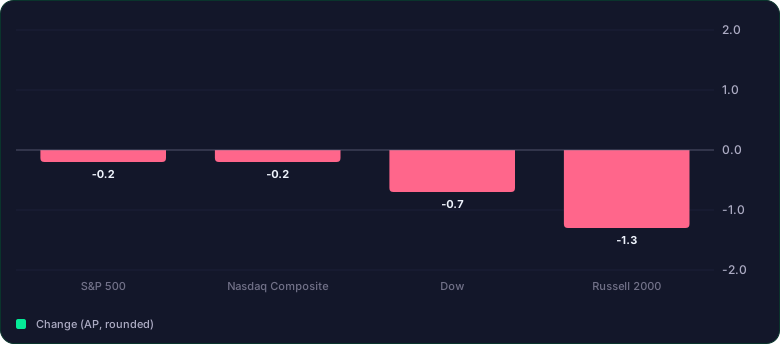
Read the chart as a table
| Change (AP, rounded) (%) | |
|---|---|
| S&P 500 | -0.2 |
| Nasdaq Composite | -0.2 |
| Dow | -0.7 |
| Russell 2000 | -1.3 |
On narrow screens, scroll the table sideways. Keyboard users can focus the table and use the arrow keys.
Today's timetable
October 8 is a normal trading day (NYSE trading hours). The table below lists only the events covered in this brief; it is not the full economic calendar for today. The weekly claims time was converted from 7:30 a.m. CDT in the FRED release calendar. The auction time is based on the Treasury's auction announcement.
Sources: NYSE trading hours · fred.stlouisfed.org · FRED release calendar · U.S. Treasury auction announcement
On narrow screens, scroll the table sideways. Keyboard users can focus the table and use the arrow keys.
| Event | EDT | PDT | Status |
|---|---|---|---|
| Waller speech Source | 4:30 a.m. | 1:30 a.m. | Released |
| Weekly jobless claims Source | 8:30 a.m. | 5:30 a.m. | Not yet released |
| Regular session opens Source | 9:30 a.m. | 6:30 a.m. | Scheduled |
| 30-year reopening: competitive bids close Source | 1:00 p.m. | 10:00 a.m. | Not yet closed |
| Regular session closes Source | 4:00 p.m. | 1:00 p.m. | Scheduled |
Weekly jobless claims: Pre-release benchmarks and what to check, in order
Today's figures are not yet out. The benchmarks below come from the previous report, released October 1 at 8:30 a.m. EDT (Labor Department report PDF). Even within the same report, the latest initial claims figure is for the week ended September 26, while the latest continuing claims figure is for the week ended September 19. Because continuing claims cover a period one week earlier than initial claims, the two are not compared side by side as figures for the same week. GSDAQ checks today's release in the following order. • First confirm the reference week stated in today's report, then look at the latest initial claims together with the four-week average, not the single-week figure alone. • Check how initial claims for the week ended September 26, which were an advance figure in the previous report, were revised. • Because continuing claims have a different reference week from initial claims, look at them separately for their trend against prior values. Waller assessed the labor market as stable. If the revisions, the four-week average and continuing claims together show a slowdown in employment, that is recorded as a condition to revisit alongside his personal assessment. Conversely, a single week's decline in initial claims alone is not taken to mean that employment has improved overall or that a hike is confirmed.
Sources: U.S. Department of Labor weekly unemployment insurance claims
On narrow screens, scroll the table sideways. Keyboard users can focus the table and use the arrow keys.
| Item | Week | Value | Note |
|---|---|---|---|
| Initial claims Source | Week ended Sept. 26 | 197,000 | Seasonally adjusted, advance |
| Initial claims Source | Week ended Sept. 19 | 198,000 | Seasonally adjusted, revised up |
| Initial claims, four-week average Source | Week ended Sept. 26 | 200,000 | Seasonally adjusted |
| Continuing claims Source | Week ended Sept. 19 | 1,701,000 | Seasonally adjusted |
30-year reopening auction: 1:00 p.m. EDT is when competitive bids close
Today's auction is a reopening of the 30-year bond with 29 years 10 months remaining to maturity, and the offering amount is $22 billion. The auction date is October 8, and the issue and settlement date is October 15 (Treasury auction announcement). 1:00 p.m. EDT (10:00 a.m. PDT) is the deadline for competitive bids; it does not guarantee when results will be released. As of this brief's cutoff, today's auction results had not been released. Once official results are out, the bid-to-cover ratio, the allotment breakdown and the high yield are checked together. Because the October 7 10-year auction has a different maturity, the strength of demand is not compared based on the level of the high yield alone.
Sources: U.S. Treasury auction announcement
About this brief
GSDAQ wrote and reviewed this brief from public sources with the help of AI tools. It is for information only and is not a recommendation to buy or sell any security or investment advice.
Sources
- Federal Reserve speech text
- Federal Reserve monthly calendar
- Federal Reserve FOMC minutes
- Federal Reserve monetary policy press release
- NYSE trading hours
- AP final tally
- channelnewsasia.com · republished full text
- fred.stlouisfed.org · FRED release calendar
- U.S. Treasury auction announcement
- U.S. Department of Labor weekly unemployment insurance claims